


Ferrari FF: Details on the 4RM system
 Jan 27, 2011 | 12:29 AM
#1

Thread Starter
| Teamspeed Junior Member
Joined: Jul 2008
Posts: 88
From: Phoenix, AZ

Ferrari FF: Details on the 4RM system
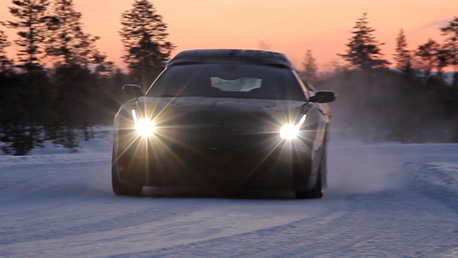
The inside scoop on Ferrari’s new FF
Paul Horrell reports back from Maranello on Ferrari’s brand-busting 4WD supercar
Can a car have 4WD for security, but still drive like a Ferrari? Can even Ferrari manage that?
Well, the FF doesn't actually have a normal heavy 4WD system with a centre diff and an extra prop shaft. It has a normal Ferrari configuration, with the drive going from the V12 back to a seven-speed twin-clutch gearbox driving the rear wheels. This is good for weight distribution, and in the dry the FF is as fast around a track as a 599 (it's only a little heavier, yet usefully more powerful). Felisa swears it feels like a proper front-engined RWD V12 Ferrari, too. And he has spoken the truth to me in these matters all the 16 years I've been interviewing him.
So what about the four-wheel drive, then? Uniquely, power is also taken off the front of the engine, which is behind the front wheel centres. It's fed to a compact lightweight unit containing a set of clutches that can progressively feed in torque to a tiny integrated gearbox and front diff. It has only two gears, roughly the equivalent of third and seventh in the main box. How can this be? Because the clutches are always slipping under electronic control, and the front tyres would never be able to make use of all the V12's torque in first or second.
What this means is the car's electronics can smoothly dial up a portion of drive to the fronts if they predict a loss of traction at the back. Yes, they're predictive as well as reactive. And they only do this in the road and slippery-road settings of the steering-wheel manettino. In the more hardcore modes, you can still run it as pretty well entirely rear-drive.
Well, the FF doesn't actually have a normal heavy 4WD system with a centre diff and an extra prop shaft. It has a normal Ferrari configuration, with the drive going from the V12 back to a seven-speed twin-clutch gearbox driving the rear wheels. This is good for weight distribution, and in the dry the FF is as fast around a track as a 599 (it's only a little heavier, yet usefully more powerful). Felisa swears it feels like a proper front-engined RWD V12 Ferrari, too. And he has spoken the truth to me in these matters all the 16 years I've been interviewing him.
So what about the four-wheel drive, then? Uniquely, power is also taken off the front of the engine, which is behind the front wheel centres. It's fed to a compact lightweight unit containing a set of clutches that can progressively feed in torque to a tiny integrated gearbox and front diff. It has only two gears, roughly the equivalent of third and seventh in the main box. How can this be? Because the clutches are always slipping under electronic control, and the front tyres would never be able to make use of all the V12's torque in first or second.
What this means is the car's electronics can smoothly dial up a portion of drive to the fronts if they predict a loss of traction at the back. Yes, they're predictive as well as reactive. And they only do this in the road and slippery-road settings of the steering-wheel manettino. In the more hardcore modes, you can still run it as pretty well entirely rear-drive.


 Jan 27, 2011 | 05:28 PM
#5

Teamspeed Senior Member
Joined: Jul 2010
Posts: 523
From: Las Vegas

Interesting but seemingly useless. So if I want to drive my 300k Ferrari in the snow it will help but it won't get me throughout the quarter mile any faster. AWD should equal more traction for faster acceleration but not in this case.


 Jan 29, 2011 | 10:40 PM
#9
Teamspeed Senior Member
Joined: Jul 2010
Posts: 523
From: Las Vegas
In the more hardcore modes, you can still run it as pretty well entirely rear-drive.

Thread
Thread Starter
Forum
Replies
Last Post
Parvin@EVOMS.com
GT
54
May 5, 2012 01:29 AM
tannermash
458 | 430 | 360
5
Jun 21, 2011 01:10 PM
PresidentialDetails
Detailing & Paint Protection
14
Jun 9, 2011 10:06 PM
Bookmarks


Currently Active Users Viewing This Thread: 1 (0 members and 1 guests)