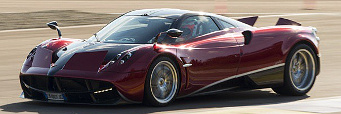
CAR Magazine Tests The Pagani Huayra [VIDEO]
 Jun 22, 2012 | 07:05 AM
#11
Teamspeed Pro
Joined: May 2011
Posts: 1,503
From: south of italy, where things get serious.


I love the Huayra, really. But I've heard from a couple of people now that know what they're talking about (engineers), that the four flaps on the TOP surface of the car simply cannot work aerodynamically, i.e. provide downforce. The only thing they can do is cause more drag, which I guess helps under braking. They look nice and add drama, which is what a hypercar is about, but I guess we'll find out once SportAuto does their Supertest, which involves a wind tunnel.
Everything that is not fully vertical and has an angle between 0º and 90º creates downforce when opposed to the wind. Also you have drag force with everything creating downforce. It is a simple trigonometry problem. For example in a plane at 45º "theorically" the amount of downforce and drag is the same. That's why the cars with heavy aerodynamic/flaps/spoilers run slower on the straights than those with less aerodynamics.
I am 90% engineer right know BTW...
 Jun 22, 2012 | 10:04 AM
#12

Teamspeed Pro
Joined: Jul 2009
Posts: 1,580
From: Connecticut
Man, this car has really grown on me. At first I didn't like it's looks and cried blasphemy at the lack of V12 roar. But, the more I see vids of this car, the more I respect it and appreciate the true art in its interior and exterior shapes and the outrageous performance it offers. From what I've read Pagani wanted to offer a uniquely different driving experience with this car, and it seems they've accomplished exactly what they set out to do (I remember reading that Horatio continually referenced airplanes/jets as influences when developing the Huayra).
All that being said, if I had the cash, I believe I'd take a Zonda 760RS over this any day.
All that being said, if I had the cash, I believe I'd take a Zonda 760RS over this any day.
Jun 22, 2012 | 11:48 AM
#13

Teamspeed Senior Member
Joined: Nov 2008
Posts: 436
What engineers have you talked with?
Everything that is not fully vertical and has an angle between 0º and 90º creates downforce when opposed to the wind. Also you have drag force with everything creating downforce. It is a simple trigonometry problem. For example in a plane at 45º "theorically" the amount of downforce and drag is the same. That's why the cars with heavy aerodynamic/flaps/spoilers run slower on the straights than those with less aerodynamics.
I am 90% engineer right know BTW...
Everything that is not fully vertical and has an angle between 0º and 90º creates downforce when opposed to the wind. Also you have drag force with everything creating downforce. It is a simple trigonometry problem. For example in a plane at 45º "theorically" the amount of downforce and drag is the same. That's why the cars with heavy aerodynamic/flaps/spoilers run slower on the straights than those with less aerodynamics.
I am 90% engineer right know BTW...
 Jun 22, 2012 | 12:46 PM
#14

Teamspeed Junior Member
Joined: May 2009
Posts: 79
From: South Germany
What engineers have you talked with?
Everything that is not fully vertical and has an angle between 0º and 90º creates downforce when opposed to the wind. Also you have drag force with everything creating downforce. It is a simple trigonometry problem. For example in a plane at 45º "theorically" the amount of downforce and drag is the same. That's why the cars with heavy aerodynamic/flaps/spoilers run slower on the straights than those with less aerodynamics.
I am 90% engineer right know BTW...
Everything that is not fully vertical and has an angle between 0º and 90º creates downforce when opposed to the wind. Also you have drag force with everything creating downforce. It is a simple trigonometry problem. For example in a plane at 45º "theorically" the amount of downforce and drag is the same. That's why the cars with heavy aerodynamic/flaps/spoilers run slower on the straights than those with less aerodynamics.
I am 90% engineer right know BTW...
Jun 22, 2012 | 01:14 PM
#15

Teamspeed Member
Joined: Sep 2011
Posts: 176
From: Boulder, CO
Yes, but car aerodynamics aren't in any way simple trigonometric planes. This is how I got it explained: The things that can create downforce at the front of a car are a splitter, and getting the air up from under the car, which the Huayra does through openings in the bonnet, much like a Lotus Elise, i.e. reducing air density under the car. At the back, a diffusor and a rear wing that's in the airflow create downforce. Look at the wings of the Carrera GT or Veyron: They rise up to the height of the roof or even above that. The Huayra flaps cannot create any significant downforce. They create drag, which might just be the desired effect under braking and to stabilize the car.
 Jun 22, 2012 | 02:11 PM
#16
Teamspeed Pro
Joined: May 2011
Posts: 1,503
From: south of italy, where things get serious.
Yes, but car aerodynamics aren't in any way simple trigonometric planes. This is how I got it explained: The things that can create downforce at the front of a car are a splitter, and getting the air up from under the car, which the Huayra does through openings in the bonnet, much like a Lotus Elise, i.e. reducing air density under the car. At the back, a diffusor and a rear wing that's in the airflow create downforce. Look at the wings of the Carrera GT or Veyron: They rise up to the height of the roof or even above that. The Huayra flaps cannot create any significant downforce. They create drag, which might just be the desired effect under braking and to stabilize the car.
Jun 22, 2012 | 10:14 PM
#17

Teamspeed Junior Member
Joined: Jan 2012
Posts: 31
maybe this will help
work on airplanes

.............Cruise ........................... Climb
"The disadvantage of the slots and flaps is that they produce higher drag. Since the high lift is only needed when flying slowly (take-off, initial climb, and final approach and landing) some designers use retractable devices, which closes at higher speeds to reduce drag."
then, huayra's flaps would be useful when braking and acceleration, not for top speed
Source: Stall & Spin
work on airplanes
.............Cruise ........................... Climb
"The disadvantage of the slots and flaps is that they produce higher drag. Since the high lift is only needed when flying slowly (take-off, initial climb, and final approach and landing) some designers use retractable devices, which closes at higher speeds to reduce drag."
then, huayra's flaps would be useful when braking and acceleration, not for top speed
Source: Stall & Spin
Jun 23, 2012 | 11:57 AM
#18

Teamspeed Senior Member
Joined: Apr 2012
Posts: 872
"The Pagani Huayra is different to its predecessor in that it incorporates active aerodynamics.[3]
It is capable of changing the height of the front from the ground and independently operating four flaps placed at the rear and front of the car.[3] The behavior of the flaps is managed by a dedicated control unit that is fed information from systems such as the ABS and ECU, which pass on information about the car's speed, yaw rate, lateral acceleration, steering angle and throttle position.[4] This is intended to achieve minimal drag coefficient or maximum downforce depending on the situation.[3]
The system also prevents excess body roll in the corners by raising the "inside" flaps (i.e. the left ones in a left-handed corner and vice-versa), increasing the downforce on that side of the car. The rear flaps also act as an airbrake. Under hard braking, both the front suspension and the two rear flaps are raised to counteract weight transfer to the front wheels and keep the whole car very stable, for instance when entering a corner.[4]
Air from the radiator is extracted through an arch in the bonnet at an angle that is designed not to affect the streamline around the body. The side air intakes behind the front wheels create a low pressure zone, resulting in downforce."
From Wikipedia.
It is capable of changing the height of the front from the ground and independently operating four flaps placed at the rear and front of the car.[3] The behavior of the flaps is managed by a dedicated control unit that is fed information from systems such as the ABS and ECU, which pass on information about the car's speed, yaw rate, lateral acceleration, steering angle and throttle position.[4] This is intended to achieve minimal drag coefficient or maximum downforce depending on the situation.[3]
The system also prevents excess body roll in the corners by raising the "inside" flaps (i.e. the left ones in a left-handed corner and vice-versa), increasing the downforce on that side of the car. The rear flaps also act as an airbrake. Under hard braking, both the front suspension and the two rear flaps are raised to counteract weight transfer to the front wheels and keep the whole car very stable, for instance when entering a corner.[4]
Air from the radiator is extracted through an arch in the bonnet at an angle that is designed not to affect the streamline around the body. The side air intakes behind the front wheels create a low pressure zone, resulting in downforce."
From Wikipedia.