


Question for the pro detailers
 Jul 26, 2013 | 02:09 PM
#1

Thread Starter
| Teamspeed Senior Member
Joined: Aug 2008
Posts: 365


Question for the pro detailers
Let me start by saying I have zero experience detailing or doing paint correction.
I have noticed in quite a few videos where vehicles are being detailed or having paint correction procedure there is talk if soft paint and hard paint. I have also noticed the market is flooded with a ton if products some actually specific to the color if your vehicle.
Is it not true that all the detailing and correcting is being performed on the clear coat layer and not the actual paint "color" layer of the finish??
Someone please enlighten me.
I have noticed in quite a few videos where vehicles are being detailed or having paint correction procedure there is talk if soft paint and hard paint. I have also noticed the market is flooded with a ton if products some actually specific to the color if your vehicle.
Is it not true that all the detailing and correcting is being performed on the clear coat layer and not the actual paint "color" layer of the finish??
Someone please enlighten me.
Jul 26, 2013 | 05:57 PM
#2

TEAMSPEED.COM

Joined: Sep 2007
Posts: 1,028
- Color based waxes are gimmicks and don't do any better than standard waxes.
- IF your car has clearcoat (some older cars don't) than the polishing is being done at that level. I have corrected many cars and there is a different level of hardness to some clears over others. Some clears are nano-ceramic and very hard and require a lot more work. It depends on the car, maybe if you could give us which car you are concerned with some of the pros here can weigh in on how hard your paint is.
- IF your car has clearcoat (some older cars don't) than the polishing is being done at that level. I have corrected many cars and there is a different level of hardness to some clears over others. Some clears are nano-ceramic and very hard and require a lot more work. It depends on the car, maybe if you could give us which car you are concerned with some of the pros here can weigh in on how hard your paint is.
Jul 26, 2013 | 11:08 PM
#3

Teamspeed Rookie
Joined: Mar 2013
Posts: 3
Here is a great picture of a cut away of different types of paint.
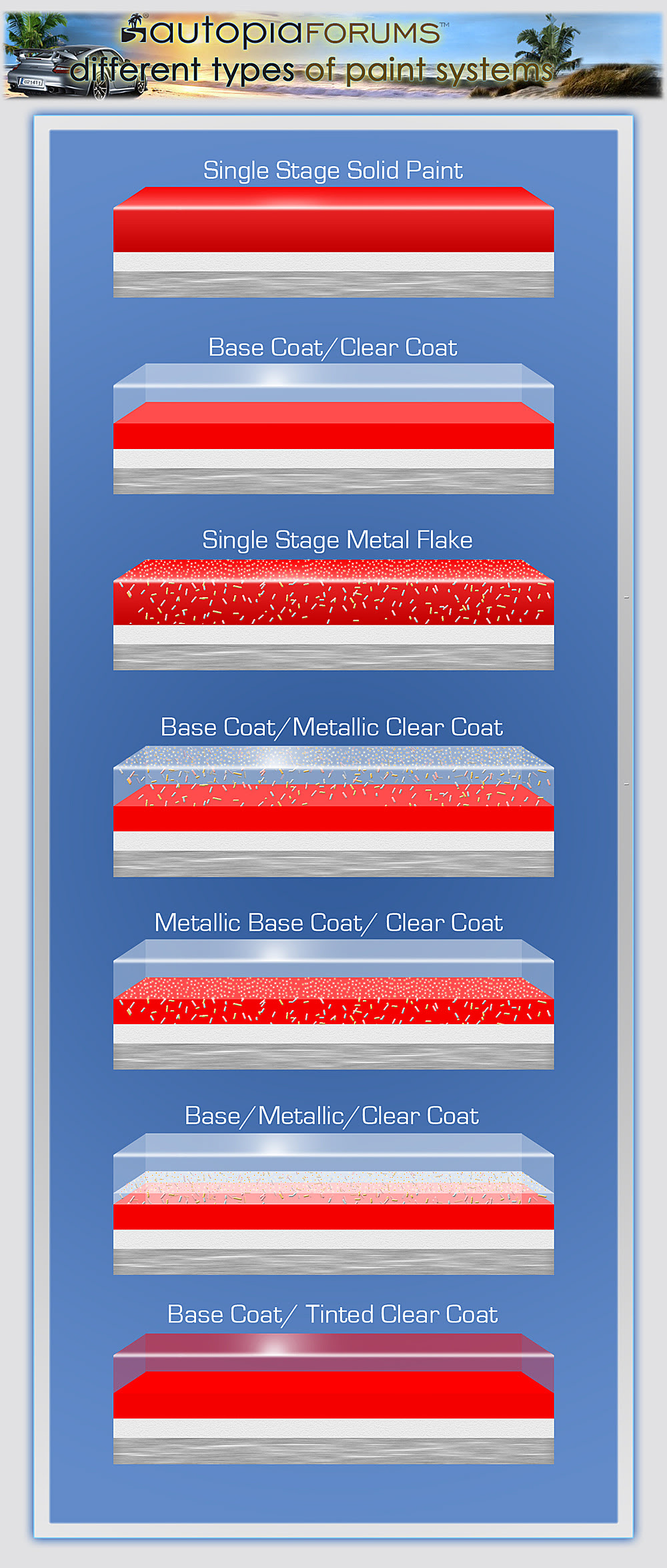
Damon is correct it depends on the manufacturer, paint type, age, and in some cases the color of the paint. For example often times black paint is going to be on the softer side of most colors.
When working with clear coat you are not actually polishing the base color coat but clear coat or top layer, which is a type of paint. When correcting paint what you are actually doing is leveling out the clear coat to remove scratches and swirl marks to ultimately achieve better light reflection from the base color. Think about how looking through a pair of glasses, the more scratches that are on the lens the more difficult it is to see through them.
As far as products go it all depends on what you need or desire and how much you want to spend. With some pictures and some more info we might be able to point you in the right direction.
Damon is correct it depends on the manufacturer, paint type, age, and in some cases the color of the paint. For example often times black paint is going to be on the softer side of most colors.
When working with clear coat you are not actually polishing the base color coat but clear coat or top layer, which is a type of paint. When correcting paint what you are actually doing is leveling out the clear coat to remove scratches and swirl marks to ultimately achieve better light reflection from the base color. Think about how looking through a pair of glasses, the more scratches that are on the lens the more difficult it is to see through them.
As far as products go it all depends on what you need or desire and how much you want to spend. With some pictures and some more info we might be able to point you in the right direction.
Jul 27, 2013 | 09:32 AM
#4
Thread Starter
| Teamspeed Senior Member
Joined: Aug 2008
Posts: 365
Thanks for the info guys, the genesis of my question was a conversation I was having with a friend who recently had a brand new vehicle "corrected" after the dealer prepped it. (Looked like they prepped it with steel wool. )
That being said anything new has a clear coat finish, so it's safe to safe all the correction is done to the clear coat not the color cost. If this is the case how much clear coat is lost on a correction and theoretically how many times could you do this do car before the clear becomes too thin?
Thanks again for all the info, always curious about this
That being said anything new has a clear coat finish, so it's safe to safe all the correction is done to the clear coat not the color cost. If this is the case how much clear coat is lost on a correction and theoretically how many times could you do this do car before the clear becomes too thin?
Thanks again for all the info, always curious about this
Jul 27, 2013 | 04:31 PM
#5
Teamspeed Rookie
Joined: Mar 2013
Posts: 3
Thanks for the info guys, the genesis of my question was a conversation I was having with a friend who recently had a brand new vehicle "corrected" after the dealer prepped it. (Looked like they prepped it with steel wool. )
That being said anything new has a clear coat finish, so it's safe to safe all the correction is done to the clear coat not the color cost. If this is the case how much clear coat is lost on a correction and theoretically how many times could you do this do car before the clear becomes too thin?
Thanks again for all the info, always curious about this
That being said anything new has a clear coat finish, so it's safe to safe all the correction is done to the clear coat not the color cost. If this is the case how much clear coat is lost on a correction and theoretically how many times could you do this do car before the clear becomes too thin?
Thanks again for all the info, always curious about this

Thread
Thread Starter
Forum
Replies
Last Post
zeeshan66
Detailing & Paint Protection
2
May 3, 2013 02:56 PM
stuka
Detailing & Paint Protection
23
Sep 9, 2010 08:05 AM
Bookmarks


Currently Active Users Viewing This Thread: 1 (0 members and 1 guests)