
McLaren Speedtail Blows Past F1 with 250 MPH Top Speed
The residual airflow over the nose of the car is directed onto and over the windscreen by a cowling at the trailing edge of the bonnet. Engineered to completely encompass both the single-arm wiper and its operating mechanism, the cowling maintains a smooth flow transition across the front of the Speedtail and then over the roof towards the powertrain’s ‘snorkel’ intake. This inlet, which provides the air intake for the internal combustion engine element of the petrol-electric powertrain, is set flush within the roof to reduce drag and cannot be seen when the McLaren Speedtail is viewed in profile.
The required flow of air to the powertrain is maintained with two intakes that slope downwards, starting just behind the glass canopy. The intakes – which are split by the central high-mounted stop light – curve down into the engine cover before disappearing from view; a shorter, more aggressive intake would cause the air to separate from the surface and pass over the intake.
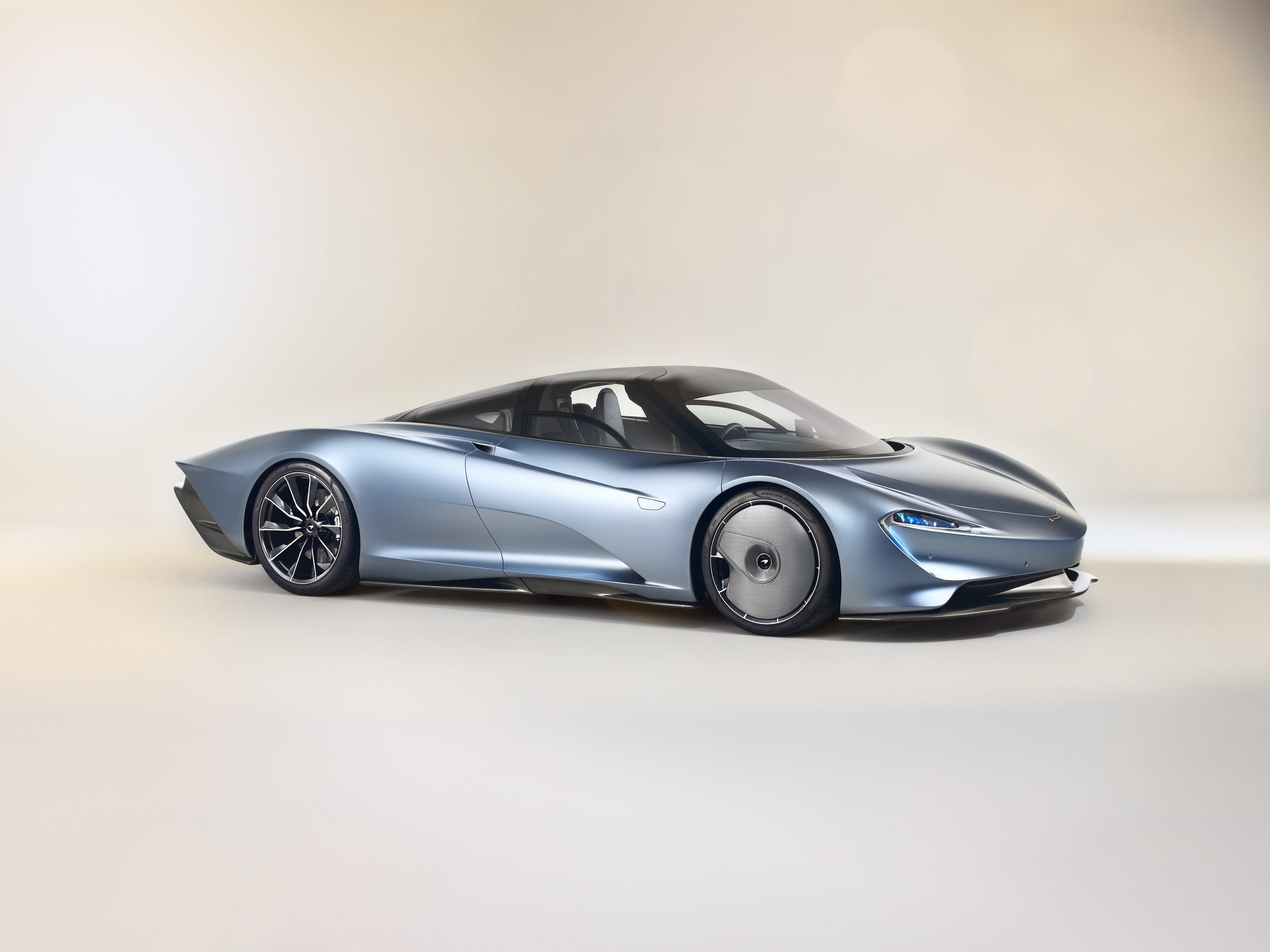
One of the innovations immediately obvious on the McLaren Speedtail is the introduction of lightweight, carbon fiber front-wheel static aero covers. Incorporated into the 20-inch, 10-spoke forged alloy front wheel design to minimize aerodynamic drag, they remain fixed in position as the wheels rotate, the flat surface smoothing airflow around what would otherwise be a turbulent aerodynamic area. Typically, the revolution of a wheel drives air away from the vehicle, but the carbon fiber front-wheel static aero covers keep the air ‘attached’ to the car and guide it onwards to the door blades on the leading edge of the dihedral doors.
The static wheel covers work in conjunction with multiple ducts and air paths to reduce turbulent air within the wheel arches. As air passes out of the LTRs, for instance, it is vented into the front wheel arches. From there – together with heat energy generated by the lightweight, carbon ceramic braking system – the air is channeled through the ducts in the fixed front wheel aero cover in a consistent flow pattern. Pressure within the wheel arches is also reduced via the lower door vents, which draw the turbulent air created by the rotating front wheels out of the arches and drive it smoothly along the sides of the McLaren Speedtail. The wheels themselves are finished in an elegant gloss black, with diamond-cut finishing. Brake calipers in Speedtail Silver complement the lustrous body color.
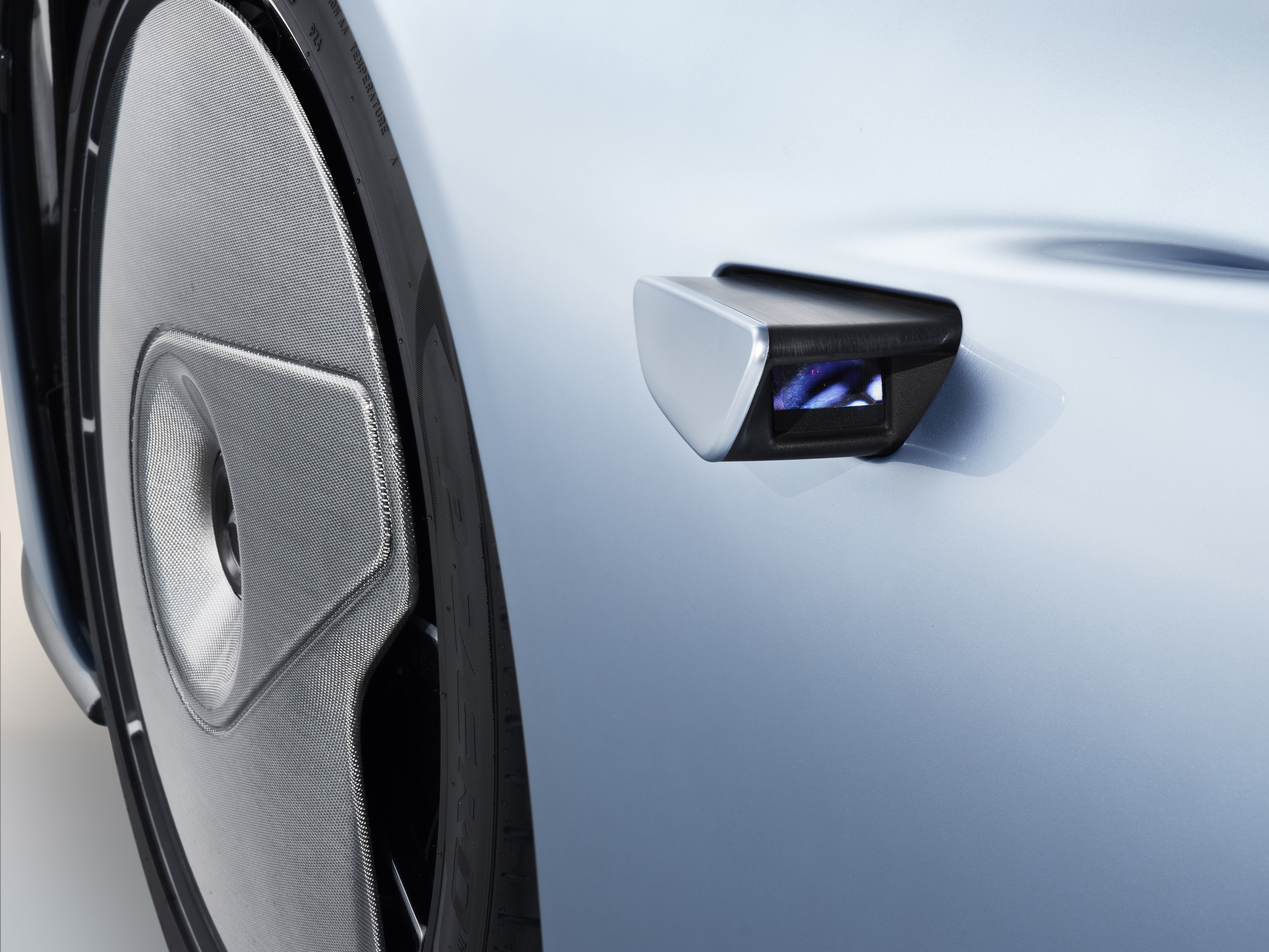
Door mirrors are notably absent, the McLaren Speedtail instead featuring two discreet, high-definition digital cameras that glide out of the doors when the vehicle ignition is activated. Traditional fixed door mirrors create a surprising amount of air turbulence, but with a significantly smaller profile, the cameras on the Speedtail have only a minimal effect on airflow; furthermore, they provide a much wider field of view of the road behind. The camera feed is displayed on two screens, positioned at either side of the instrument panel in front of the driver. When Velocity mode is selected, the cameras retract into the doors, reducing drag further still.
Utilizing the same aerodynamic principles proven on the McLaren P1™, second-generation McLaren Super Series and McLaren Senna, intakes for the HTRs (High-Temperature Radiators) are mounted on the shoulders of the Speedtail, within the double-skinned dihedral doors. The raised front wings, compact cockpit glasshouse and flush glazing serves to keep the airflow attached to the vehicle and drive it over the front fenders and into the deep channels within the doors to provide cooling for the 1,035bhp hybrid powertrain. Such is the efficiency of this solution that the HTR intakes of the McLaren Speedtail are particularly compact, further minimizing drag.
You must be logged in to post a comment.