
Watch Koenigsegg Crash a $2 Million Hypercar
Trust us, it is for a good reason. Go inside Koenigsegg to learn the unique details involved in crash-testing a full carbon fiber hypercar.
Recently, Team Speed featured a video from Apex.ONE about the new Koenigsegg Agera replacement, the Jesko. We gave a little background on Apex.ONE and it’s successful documentary Apex: The Story of the Hypercar. Making that documentary, which spotlights Koenigsegg, helped Apex.ONE get insider details, which they reveal in the new YouTube video, above.
Apex.ONE’s new clip provides a behind-the-scenes look at what it takes to crash-test one of Koenigsegg’s $2 million hypercars. The video starts off with Koenigsegg’s Homologation Manager David Tugas talking about the logistics of a crash test car. According to Tugas, it takes a little more than three months to prepare one of Koenigsegg’s crash cars.
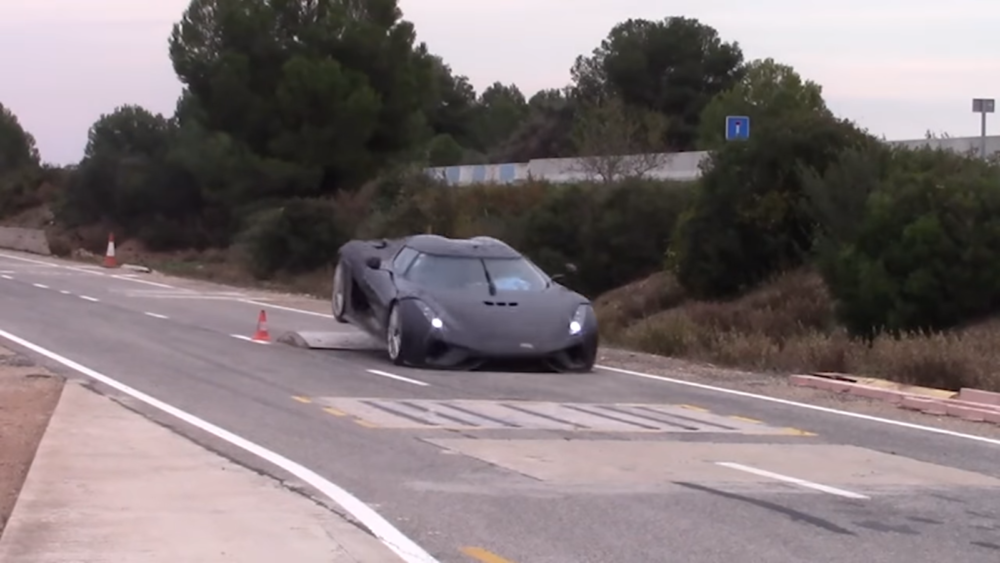
“It’s really hard to watch as the car is slowly being destroyed, hammed, over-torquing it, and then finally crushing it against a wall,” says Tugas. “It’s painful to watch.”
Christian von Koenigsegg talks about the testing done for the United States, revealing that they test Koenigsegg cars without belts, and they install smart airbags. The airbags are able to sense if it’s a small or big person sitting in the car, the person’s location on the seat, if they have a belt or not, and which angle the car is hitting an object from. The car’s airbag safety system deployment, strength, and volume is then tuned based on learning all of those factors. The only way to get the data, is to crash the car.
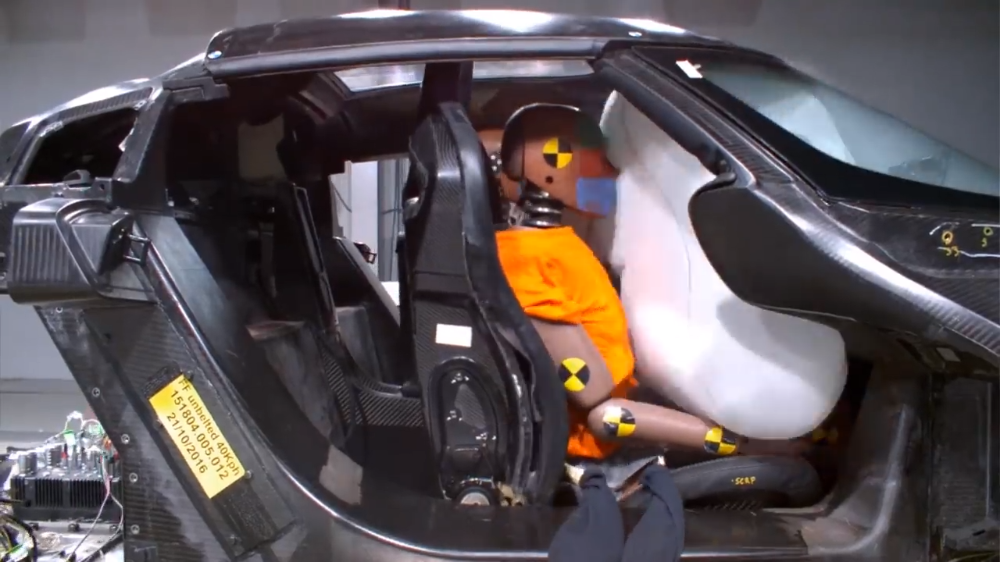
“In order to get the data to be able to do that and to program these systems, we have to crash our cars from every conceivable angle at different speeds from the side, from the rear, from the front, the front offset corner,” says von Koenigsegg.
Regular high-volume car manufacturers simply pull a car from the production line, crash test it, then scrap it. But not Koenigsegg. It is not financially feasible to crash test multiple cars for multiple scenarios, so Koenigsegg uses the same carbon fiber structure for every test.
“To save money for this process, we designed our carbon fiber monocoque to withstand all these different types of crash tests without being destroyed,” adds von Koenigsegg.

It isn’t easy to watch, but the reasons behind the crash tests are sound, and the video offers unique insight into the creation (and destruction) of one of the world’s greatest supercars.
Join the Team Speed forums now!

You must be logged in to post a comment.