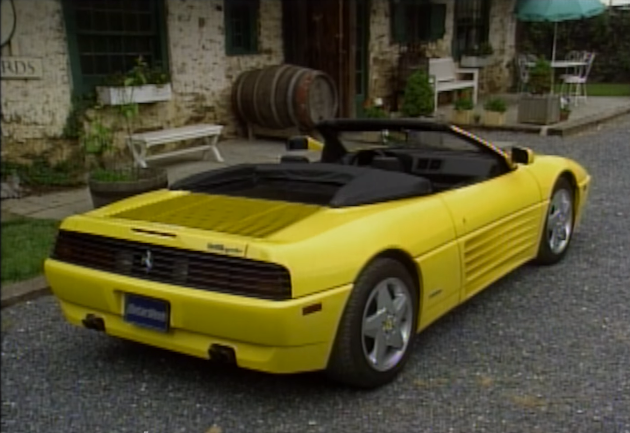
These bright yellow Ferrari siblings were even more exotic than the regular 348 that served as their foundations.
A Ferrari is the rolling definition of an exotic car. It’s a rare sight in most parts of the world. Its lines are eye-catching, dream-inspiring, and lust-stirring. Its performance is worth the staggering price tag attached to it.
So how does Ferrari make one of its cars even more exotic? Easily. It removes the roof or gives it more power. According to the above MotorWeek video, Ferrari did both with the 348 Spider and Speciale, respectively.
The 348 GTS gave Ferraristi the ability to have the wind flow through their hair when they had the targa top stored, but the Spider completely immersed them in the open air driving experience. Thanks to less restrictive intake and exhaust systems, the Spider also gave their ears a greater sonic treat than the regular 348 could provide.
The Spider’s 3.4-liter V8 also gave it a slight power edge over its more pedestrian cousin, generating 312 horsepower and 229 lb-ft of torque, and a 0-60 mph time of 5.8 seconds. The quarter mile came up in 14.2 seconds, when the 348 Spider was doing 101 mph. The V8 put its extra power to the road through a stiffened chassis, revised suspension settings, and a wider rear track. Whoever drove the 348 Spider had to be just as enhanced because the Spider’s gated shifter, manual steering setup, and brakes only respected and responded to strength.
Although not as liberating as the Spider, the 348 Speciale was…well…special in its own right. It had the same engine as its drop-top sibling, the same body-color lower sides treatment, and even its own unique taillight design. MotorWeek found the entire package to be more attractive than the Spider. The people who didn’t order one of the 100 Speciales that Ferrari made in time must’ve found it to be elusive, another quality of an exotic car – and a perfect one for any Ferrari to have.
Derek Shiekhi's father raised him on cars. As a boy, Derek accompanied his dad as he bought classics such as post-WWII GM trucks and early Ford Mustang convertibles.
After loving cars for years and getting a bachelor's degree in Business Management, Derek decided to get an associate degree in journalism. His networking put him in contact with the editor of the Austin-American Statesman newspaper, who hired him to write freelance about automotive culture and events in Austin, Texas in 2013. One particular story led to him getting a certificate for learning the foundations of road racing.
While watching TV with his parents one fateful evening, he saw a commercial that changed his life. In it, Jeep touted the Wrangler as the Texas Auto Writers Association's "SUV of Texas." Derek knew he had to join the organization if he was going to advance as an automotive writer. He joined the Texas Auto Writers Association (TAWA) in 2014 and was fortunate to meet several nice people who connected him to the representatives of several automakers and the people who could give him access to press vehicles (the first one he ever got the keys to was a Lexus LX 570). He's now a regular at TAWA's two main events: the Texas Auto Roundup in the spring and the Texas Truck Rodeo in the fall.
Over the past several years, Derek has learned how to drive off-road in various four-wheel-drive SUVs (he even camped out for two nights in a Land Rover), and driven around various tracks in hot hatches, muscle cars, and exotics. Several of his pieces, including his article about the 2015 Ford F-150 being crowned TAWA's 2014 "Truck of Texas" and his review of the Alfa Romeo 4C Spider, have won awards in TAWA's annual Excellence in Craft Competition. Last year, his JK Forum profile of Wagonmaster, a business that restores Jeep Wagoneers, won prizes in TAWA’s signature writing contest and its pickup- and SUV-focused Texas Truck Invitational.


You must be logged in to post a comment.